Showing posts with label Photography. Show all posts

Saturday, 28 August 2010

What is white balance?

Welcome to the 11th weekly edition.
I wanted to show you the photograph below. I had forgotten how beautiful it was until I saw it again recently. On his first time of seeing it Henri Cartier-Bresson said, "I couldn't believe that such a thing could be caught on camera, so I grabbed my Leica and went out into the street." In 1952, he published 'The Decisive Moment' in which he wrote: 'It is the simultaneous recognition, in a fraction of a second, of the significance of an event as well as a precise organisation of forms, which give that event its proper expression'. 


Martin Munkacsi
Martin Munkacsi's easy image is such a fine example of  life giving us pictures.  'The precise organisation of forms' so aptly described is still as important today as it was in 1931 when the photograph was taken. This is probably the first of its kind and is a reference point for many when looking at this type of picture. Many photographers have taken similar pictures to this but  this was the impulse for many.
Photographic inspiration takes all forms from film to surrealist art.
As photographers we have seen images that filled us with a sense of awe and amazement. This photograph inspired one of the greatest documentray photographers ever and I hope you like it.

What is White Balance?
The pdf below explains what white balance is and how you can improve your photographs by understanding it. The important thing to remember is that a pure white does not exist.  If you are photographing a white plate on a white table cloth you will notice there is a difference in the tone between the two. If you are lighting this with daylight as the brightness of the sun changes so does the colour reflected down the lens. This shift in colour is caused by the 'White Balance.'
"The camera is my tool. Through it I give a reason to everything around me." Andre Kertesz

What is White Balance? -

Wednesday, 21 July 2010

Stolen from Nikon 3 steps to great portraits.

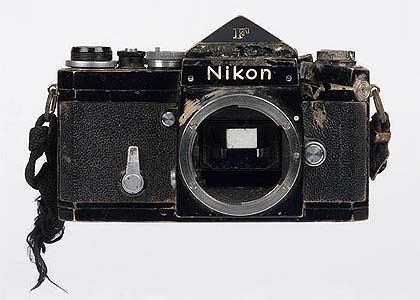
Don McCullin (Taken on a Nikon)
Welcome to the 7th edition.
We all take portraits in fact it is the most popular form of photograph. I bet you have taken loads from your first few attempts at photography and will take many more in your life time.
How do we make your subjects look like Kate Moss and help you to produce work like Nick Knight.
I am going to share with you three tips that will make a difference, they have been liberated from the Nikon website and improved upon. Nikon just want you to buy their cameras not surprisingly and the tips are fairly universal.
Don McCullin's camera

I am not trying to break new ground just give you some tried and tested industry tips that will help to give your work a commercial edge. I went to the Wolfgang Tilmans show during the week and it was quite a good reflection on communication shot in his unique style. It is at the Serpentine Gallery and is worth going to see just for the Serpentine Pavillion designed by Jean Nouvel. There are many reviews on the show so you do not need another one from me.
A recent class of mine really liked Nigel Parry so you might like to have a look at his work to get you thinking about what you consider good portrait photography to be.

"Ultimately suucess or failure in photographing people depends on the photographer's ability to understand his fellow man." Edward Weston.


3 Steps to Great Portraits -

Saturday, 3 July 2010

what are pixels and how do they affect image quality

Classic Alfred Stieglitz photograph, The Steer...Image via Wikipedia
Most of us get into photography because it is fun and creative. We generally do not do it because we love science, there are of course exceptions and you know who you are....

Photographers have always needed some knowledge of science and I wanted to provide information on a area that confuses many new to the medium, pixels.

What are they? How many do I need?

The pdf below is intended to give you an introduction and clear up some widely held misconceptions about them.

I trust that this is of use to you and I look forward to hearing from you.

After following the crowd for a while, I'd then go 180 degrees in the exact opposite direction. It always worked for me, but then again, I'm very lucky. - Elliott Erwitt - on getting a different picture.


Mega Pixels -